First-edition pricing · The Old Money CodeNext price: $49
The Old Money Code · By Frank Whitmore

The rooms read
conduct, not
net worth.

A field guide to the rooms, the rules, and the conduct that old money reads — room by room, with a cheat card for each.

PDF · One payment · Lifetime access
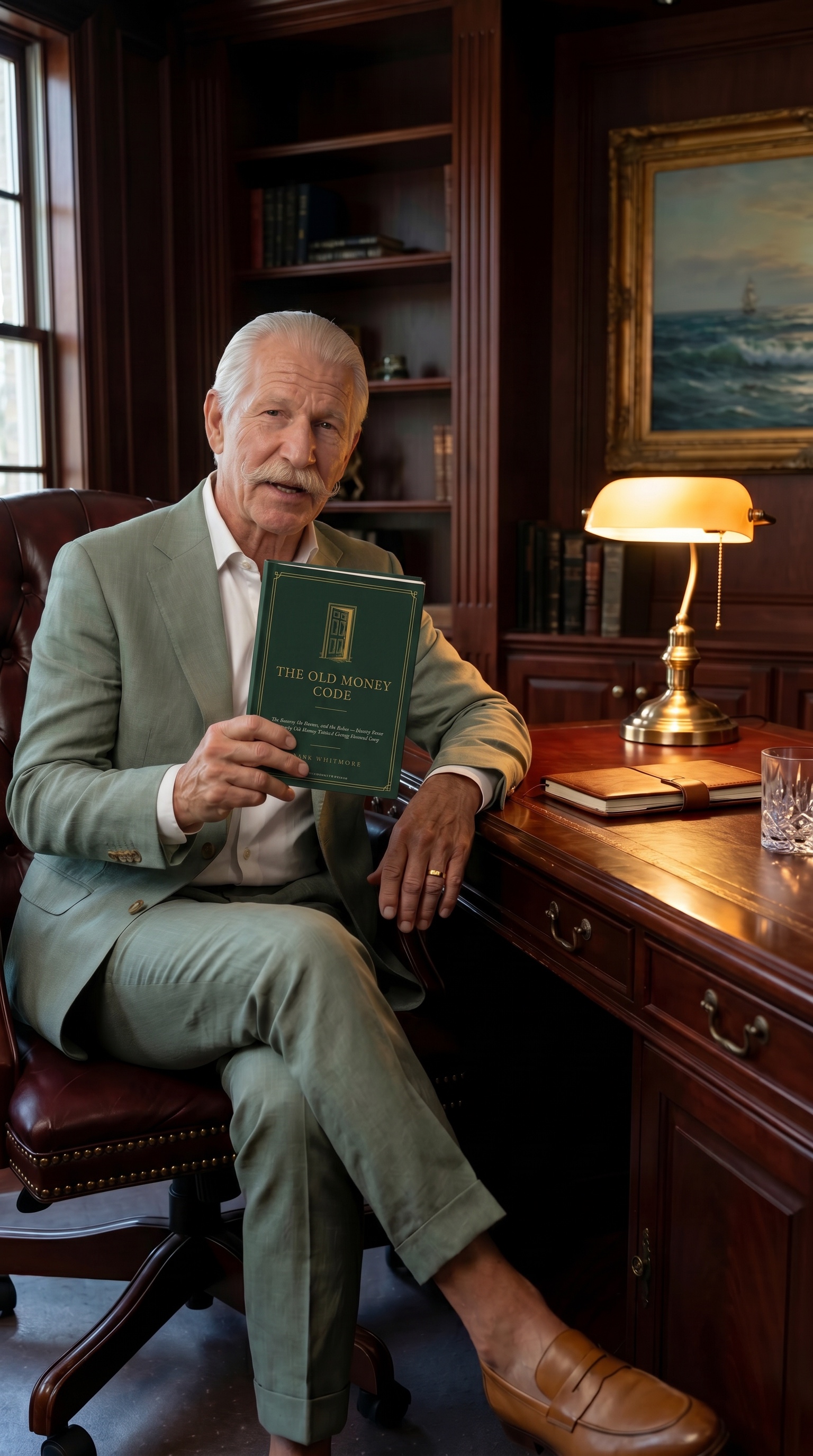
Frank Whitmore holding The Old Money Code
★★★★★
4.8 average
13 chapters
12 cheat cards
Read in an evening
The problem

Nobody will tell you the rules.

You earn well. You dress well. You still feel the floor tilt in certain rooms — and nobody will ever hand you the code.

The dinner where the wine list lands in front of you. The wedding with a dress code you had to Google. The client's club. The partner's house. These rooms read conduct, not net worth — and the rules were never written down anywhere you could find them.

What you were told
False belief I
It's about net worth
Old money reads ease, restraint, and attention. Your car, your brand, your bank — genuinely irrelevant in the first five minutes.
False belief II
Buy the right brands
You can spend on the right labels and still get read as new money. Fit and restraint outrank logos every time.
False belief III
They are testing you
Nobody administers tests. Rooms simply notice — and what they notice is a short, learnable list.
False belief IV
Etiquette is Victorian cosplay
The code is not about forks. It is about how you treat the staff, what you never say, and whether you can be comfortable in silence.
False belief V
Fake it until you make it
Trying to be impressive is the single fastest self-outing in every room. The code is conduct, not performance.
If you've thought this

These thoughts arrive before the room does.

They sit behind the dinner-table conversation. They are the reason you picked up this page.

I make good money and still feel like an impostor in certain rooms.
The dinner terrifies me — the forks, the wine list, the bill.
I freeze when someone asks what I do — or I say too much.
I spend on the right brands and still get read as new money.
I don't know the rules of the invitation — gifts, RSVPs, thank-yous.
I don't know how to behave in someone's club, box, or country house.
My online presence probably undoes me and I don't know how.
Small things give me away — tipping, thanking, laughing, haste.
The field guide

The code is learnable. Old money teaches it to its children. Nothing innate about it.

The door

For thirty years, Frank Whitmore watched who was read as belonging and who gave themselves away — inside the dinners, the clubs, the houses. He was not born to the rooms. He learned them by serving them.

This book writes the code down. Room by room. One rule per chapter. One cheat card per room. Read it straight through in an evening — or open the card the night before you need one.

The first rule

The rooms read conduct, not net worth.

The framework

The 10 Unwritten Rules.

One list, stated once. The reader can recite the book from this page. One rule surfaces per chapter — some chapters share.

1
The rooms read conduct, not net worth.
2
Quiet is the loudest signal.
3
Restraint is the entire money secret; the rest is arithmetic.
4
They are not testing you. They are noticing you — there's a difference, and it's worse.
5
Never discuss price, income, or inheritance. Ever. Anywhere.
6
Ease outranks correctness — the relaxed wrong fork beats the anxious right one.
7
How you treat the staff is the whole interview.
8
One signal maximum — in dress, in speech, in stories.
9
The thank-you note is the cheapest status instrument on earth.
10
You are always in a room. (Including online.)
The book

Thirteen chapters. Twelve cheat cards.

Three parts — the secrets, the rooms, the person. Each chapter ends with a card you can read the night before you need it.

Every chapter opens with the rule, names the one mistake that outs you fastest, and closes with a cheat card — everything above in ten lines.

Part I — The Secrets · The code itself
Ch 1
The First Secret: It Was Never About the Money
What old money actually notices — and what it genuinely doesn't.
The rooms read conduct, not net worth.
Ch 2
The Quiet Rules of Money
Old money's money habits as pure principles — no products, no returns promised.
Restraint is the entire secret.
Ch 3
How They Read You: The Silent Noticing
Nobody administers tests. Rooms simply notice — and what they notice is learnable.
They are not testing you. They are noticing you.
Ch 4
The Vocabulary: How Old Money Talks
The five prohibitions — and what to say instead in each trap.
Never discuss price, income, or inheritance.
Part II — The Rooms · The field guide
Ch 5
The Dinner Party
Arrival, seating, cutlery, conversation duties, the exit, the note within three days.
Ch 6
The Restaurant
Ordering, the wine list, the bill, tipping, treating the waiter as a colleague.
Ch 7
Weddings, Funerals & Ceremonies
Dress codes decoded, gifts, RSVP discipline, the toast in three movements.
Ch 8
The Club, the Course, the Box
Guest humility, dress codes, golf etiquette for the non-golfer, the box at the game.
Ch 9
Their Home
The invitation to the house — arrival, the gift, the tour, the weekend-guest protocol.
Ch 10
The Business Room
Relationship before transaction, understatement in the pitch, discretion as credential.
Ch 11
Hosting Them at Yours
Simplicity outranks spectacle. Never apologize for your home.
Part III — The Person
Ch 12
Dress: The Quiet Uniform
Fit is the luxury. One signal maximum — in dress, in speech, in stories.
One signal maximum.
Ch 13
The Digital Room
Your feeds are read before every dinner, interview, and deal.
You are always in a room — including online.
Close
The 30 Days of Quiet
Thirty one-line daily practices. The reader closes the book with something to do tonight.
Also included
In the book
The Cheat Cards, collected
All 12 cards in one place — printable, one per room, ready the night before.
In the book
The 10 Unwritten Rules
One page, the tear-out. The list you can recite from memory.
In the book
Frank's short shelf
Five books, one line each. The reading behind the code.
In the book
The 30 Days of Quiet
Thirty one-line daily practices — write one note, eat one dinner phone-away, rehearse the introduction.
By the numbers
4.8Average rating
13Chapters · 3 parts
12Cheat cards
Frank WhitmoreFrank Whitmore
Who is writing this

He holds the door open.

Frank Whitmore spent thirty years as a steward of wealthy families' affairs — inside the dinners, the clubs, the houses — watching who was read as belonging and who gave themselves away, and exactly how.

He was not born to the rooms. He learned them by serving them. That is his authority and his warmth: he holds the door open for the reader on the doorstep.

This book is what he found — written plainly, without motivation, for the person who is tired of broadcasting that they're new and wants the actual code instead.

Frank Whitmore
Reader responses

Unbriefed no longer.

★★★★★

I read Chapter 5 the night before a partner dinner. I didn't photograph the table. I wrote the note within three days. Nobody said anything — which, I now understand, is the point.

Claire Whitmore
Management Consultant, Boston
★★★★★

The Restaurant Card sits in my wallet. The wine list no longer terrifies me. The bill no longer gets a performance. Small change. Large difference in how the room reads me.

James Okonkwo
Founder, London
★★★★★

I finished it in one sitting. Then I opened the Dinner Card again the following Friday. This is the first etiquette book that doesn't feel like cosplay or fakery.

Sophie Laurent
Reader, Paris
★★★★★

The "what do you do?" script alone was worth the price. One plain sentence, ending in a question. I rehearsed it in the car. It worked exactly as written.

David Chen
Attorney, San Francisco
★★★★★

I audited my last twenty posts after Chapter 13. Deleted four. The digital room chapter is the one nobody else is writing — and the one that probably mattered most.

Amelia Torres
Marketing Director, Miami
★★★★★

Sent it to my sister without comment. She texted back three days later: "Why didn't anyone tell us this." That felt like the right review.

Thomas Reid
Reader, Edinburgh
The Dinner Card alone.— M.H., New YorkFinally, a field guide — not a wealth system.— A.P., SydneyRead it the night before. Used the card.— T.N., LagosOne evening. Kept for life.— R.W., DubaiThe best $27 I have spent this year.— S.K., SingaporeThe Giveaway framing is brutal and useful.— O.C., DublinFrank holds the door open. That's the tone.— F.L., ParisStopped performing for rooms I hadn't entered yet.— M.T., SeattleThe Dinner Card alone.— M.H., New YorkFinally, a field guide — not a wealth system.— A.P., SydneyRead it the night before. Used the card.— T.N., LagosOne evening. Kept for life.— R.W., DubaiThe best $27 I have spent this year.— S.K., SingaporeThe Giveaway framing is brutal and useful.— O.C., DublinFrank holds the door open. That's the tone.— F.L., ParisStopped performing for rooms I hadn't entered yet.— M.T., Seattle
First-edition pricing

Open the door.

The Old Money Code
The complete field guide
+ all 12 cheat cards
Read in an evening. Keep for life.
First-edition pricing · Ending soon · Next price $49
$49$27USD
  • The Old Money Code — the complete PDF ebook
  • All 12 Cheat Cards — printable, one per room
  • The 10 Unwritten Rules — tear-out page
  • The 30 Days of Quiet — closing drill list
  • Lifetime access
  • 30-day refund, no questions asked
Open the door — $27

Secure checkout · Instant PDF delivery · Lifetime access

This is general education, not legal or financial advice. Chapter 2 covers money habits at the principle level only.

Questions

The ones people actually ask.

Men and women 25–50 who earn well or are starting to — first-generation professionals, business owners, strivers — who keep finding themselves in rooms with genuinely wealthy people and feeling the floor tilt. You are not trying to fake a fortune. You are trying to stop broadcasting that you're new. The code is learnable. Frank was once unbriefed too.
No. The code is not about forks. It is about conduct — how you treat the staff, what you never say, whether you can be comfortable in silence, and the one mistake that outs you fastest in each room. Frank writes plainly, without mockery, for the reader who is simply unbriefed.
Straight through in an evening — or by room, the night before you need one. Part I covers the secrets. Part II is the field guide, one room per chapter. Part III covers dress and the digital room. Each chapter ends with a cheat card designed for the second use case.
Thirty days, no questions. If you read it and it was not worth your time, write to the address in the back matter and the refund is processed the same day.
First-edition pricing. The next price is $49. The reasoning is straightforward: the first thousand readers carry the word. The value is not priced into the current number. When the price changes, it will not come back down.

The rooms were never locked. The key is conduct — and now you have it.

Nobody in the room is looking at your watch.
They are looking at how often you look at it.

Open the door — $27

$27 · PDF · Instant access · 30-day refund